 Skip to content

As the shipper, you carry the primary legal responsibility for your dangerous goods. You must classify them, package, mark and label them, and document them correctly before they leave your premises. In 2027 the rules for air, road and sea all change, so the way you prepare some shipments will need to change too.
This year’s updates focus heavily on batteries, but there are also new classification entries, new packaging and loading requirements, and a new duty to check vehicles before they go by sea. Here’s what you need to know, and what to do before your next shipment.
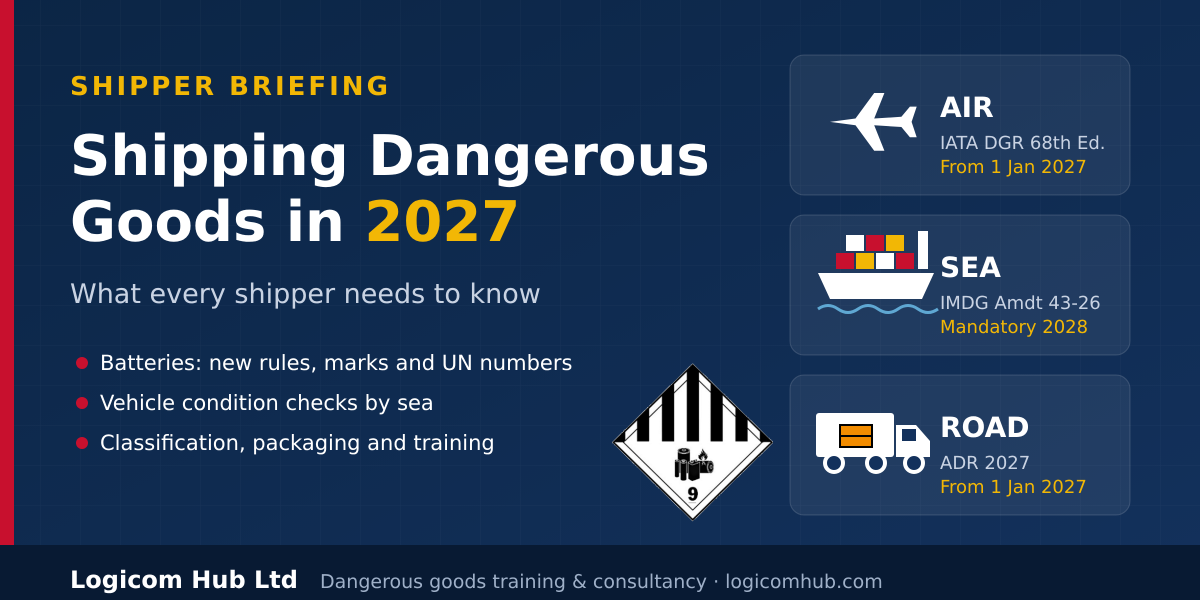
Key dates at a glance
| Mode | Regulations | New rules apply | Old rules still usable |
|---|---|---|---|
| Air | IATA DGR 68th Edition | 1 January 2027 | No general transition period |
| Road | ADR 2027 | 1 January 2027 | ADR 2025 until 30 June 2027 |
| Sea | IMDG Code Amendment 43-26 | Optional from 1 January 2027 | Mandatory from 1 January 2028* |
If your goods travel by more than one mode, different legs may follow different editions during 2027. Agree with your forwarder and carriers which edition your paperwork should follow.
*IMDG dates are taken from the draft amendments and are subject to final IMO adoption.
Five changes every shipper should understand
1. Batteries: check how you classify, test and mark them
If your products contain or are packed with batteries, this is the biggest change in every mode.
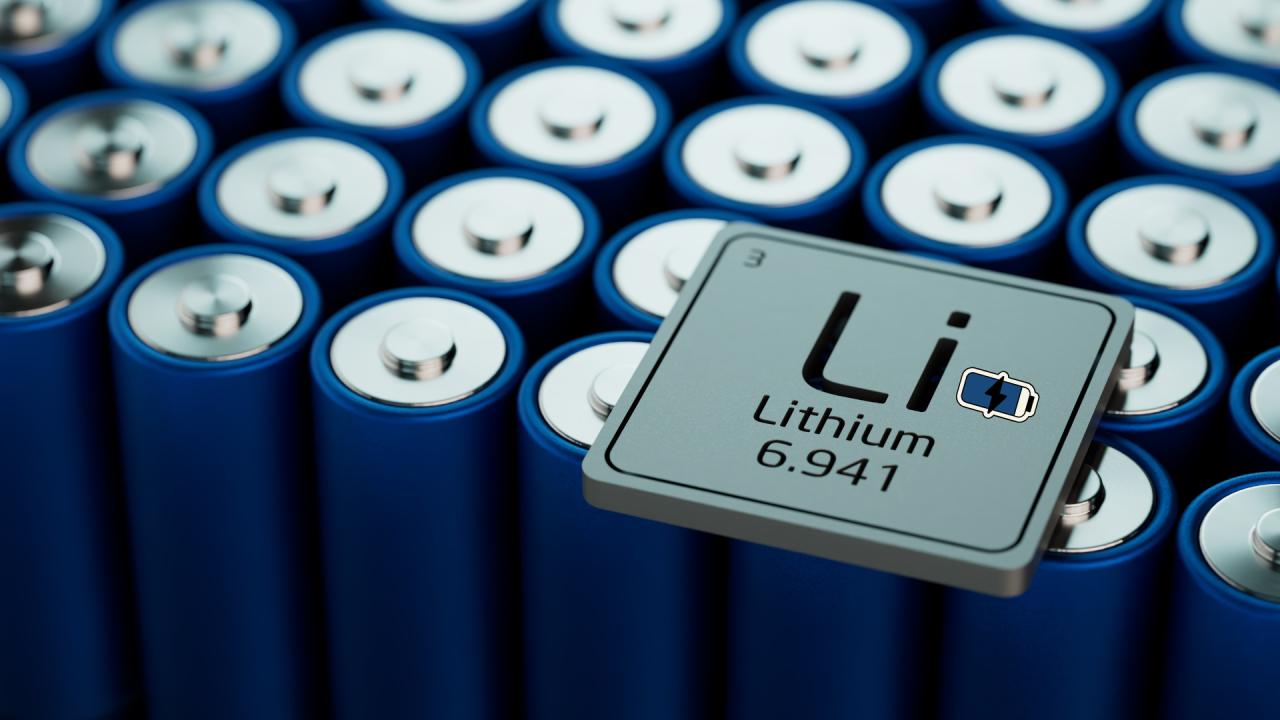
- Hybrid batteries with both lithium-ion and sodium-ion cells now have their own rules. They are shipped as lithium-ion batteries, and under SP 188 they are limited to 100 Wh, with the Wh rating marked on the case.
- Repaired, refurbished or remanufactured batteries may no longer count as the tested type, so you may need a new UN 38.3 test summary. This matters for returns, repairs and second-life batteries.
- The battery mark: the old version with a telephone number is being phased out, so use the current design. Where other hazard labels are also needed, the battery mark must go on the same side as them.
- Button cells inside equipment no longer count toward package limits, and you don’t need to show their UN number on the mark.
- New UN numbers: UN 3563 and UN 3564 cover battery energy-storage units built into containers. UN 3536 now covers lithium-ion only.
- Articles and equipment: articles that contain batteries as their only dangerous goods must now be shipped as UN 3091, 3481 or 3552, as appropriate.
2. Vehicles and machinery: your duty to check before shipping by sea
Under a new IMDG special provision (SP 980), the shipper must assess a vehicle’s safety condition before offering it for sea transport. A vehicle cannot be shipped if it is leaking, has damaged wiring or airbags, or has been through a flood, fire or similar event, unless it has been repaired and the repair checked. Batteries that are damaged or defective must be removed. If you export used vehicles, EVs, plant or machinery, you’ll need a documented inspection process.
3. Classification: review your product data and safety data sheets
- UN 1040, 1041, 1727, 2372 and 3300 gain a corrosive or toxic subsidiary hazard, which means new labels, documentation and segregation.
- UN 2941 (fluoroanilines) is deleted, and the chlorophenol entries are restructured, with new UN 3561 and 3562.
- Heating machines, such as heat pumps, can now be shipped under UN 2857 and UN 3358, alongside refrigerating machines.
- Aerosols whose contents meet the criteria of certain hazard classes (for example explosives, organic peroxides, or packing group I toxic or corrosive substances) are now forbidden.
- Modern MRI scanners have a dedicated provision, and medical devices containing batteries must be shipped under the relevant battery entry.
- For infectious substances, if you are unsure whether something is Category A, it must be treated as Category A.
4. Packaging and marking
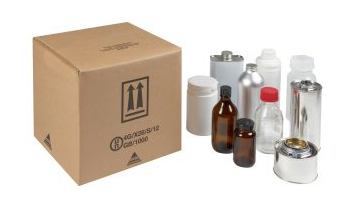
- Stacking orientation (road and sea): packages that passed a stacking test must be loaded the same way up as they were tested. Make sure your packages show clearly which way is up.
- Organic peroxides and self-reactive substances: metal packagings that meet the packing group I pressure test must no longer be used, so check with your packaging supplier.
- Environmentally hazardous mixtures (UN 3082): certain 5–20 litre plastic drums with removable heads are exempt from the performance tests until 2034, provided conditions are met.
- Air: an overpack doesn’t need to repeat every mark on the packages inside it, and excepted quantities now apply only to substances, not articles.
- Road: empty, uncleaned drums and IBCs can now go for disposal or recycling even if their test dates have expired, provided conditions are met.
5. Documents and training
- Air: the guidance for completing the Shipper’s Declaration has been restructured. IATA has also changed many airline (operator) and State variations, so check them before you ship.
- Road: where packaging is approved under P911 or LP906 for specific conditions, you must now give the loader and carrier a description of those conditions, attached to the transport document.
- Training: ADR training and record-keeping now cover anyone in an “equivalent role”, so anyone in your business who prepares dangerous goods shipments must be trained to the new editions.
Your 2027 shipper checklist
- Review the classification of every dangerous goods product you ship against the new editions
- Update your product master data, safety data sheets and dangerous goods software
- Check you hold a valid UN 38.3 test summary for each battery type, including repaired or refurbished batteries
- Replace old battery marks and check where they are placed on your packages
- Introduce a documented condition check for any vehicles or machinery you ship by sea
- Confirm with your packaging suppliers that your packaging still meets the requirements
- Check airline and State variations before booking air shipments
- Make sure everyone who prepares, packs or documents dangerous goods is trained to the 2027 rules
How Logicom Hub can help
If a shipment is rejected or delayed, it’s usually down to something the shipper prepared: the classification, the packaging, the marks or the paperwork. Logicom Hub provides dangerous goods training and consultancy for shippers across air, sea and road, and our courses are being updated for the 2027 changes. Whether you need refresher training for your team, a review of your shipping procedures, or advice on a specific product, we can help you get ready.
For a full list of the Significant Air changes from IATA
If you would like a list of ADR or IMDG changes please reach out to the team
Get in touch at logicomhub.com 0330 912 5041 to discuss your 2027 training needs.