 Skip to content
Continuing our series exploring the 9 Classes of Dangerous Goods, we now move on to Class 5 Dangerous Goods – Oxidising Substances and Organic Peroxides.
If you missed our previous article, you can read our guide to Class 4 Dangerous Goods – Flammable Solids, Substances Liable to Spontaneous Combustion and Substances which, in Contact with Water, Emit Flammable Gases.
Although Class 5 substances are not always combustible themselves, they can present a significant transport risk because they may cause or intensify fires or undergo dangerous chemical decomposition. Correct classification, packaging, marking, labelling and handling are therefore essential when transporting these substances.
What Are Class 5 Dangerous Goods?
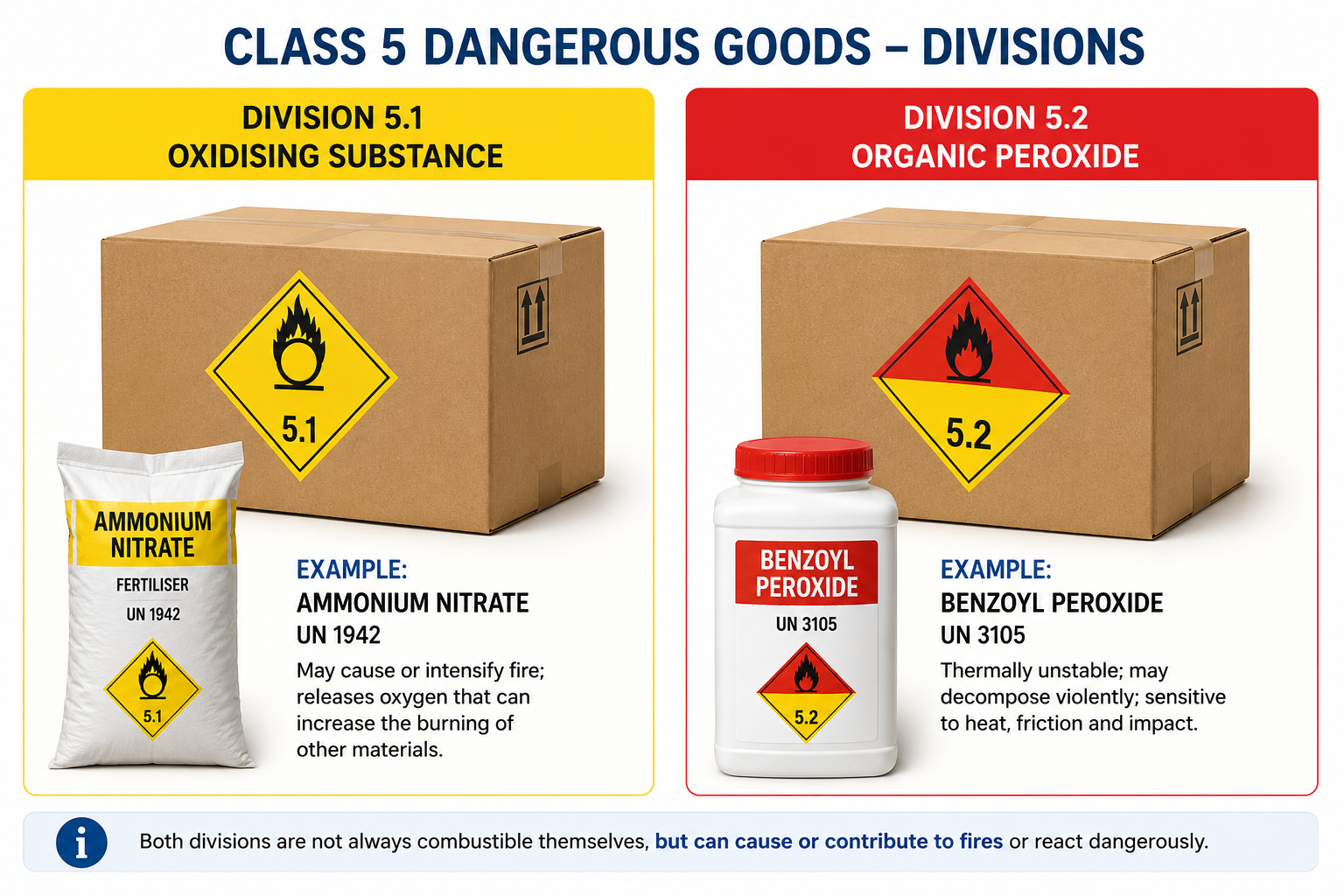
Class 5 Dangerous Goods are divided into two divisions:
- Division 5.1 – Oxidising Substances
- Division 5.2 – Organic Peroxides
Division 5.1 – Oxidising Substances
Oxidising substances are materials which, although not necessarily combustible themselves, may generally cause or contribute to the combustion of other materials by yielding oxygen.
This means an oxidising substance can make a fire more intense and increase the rate at which other materials burn.
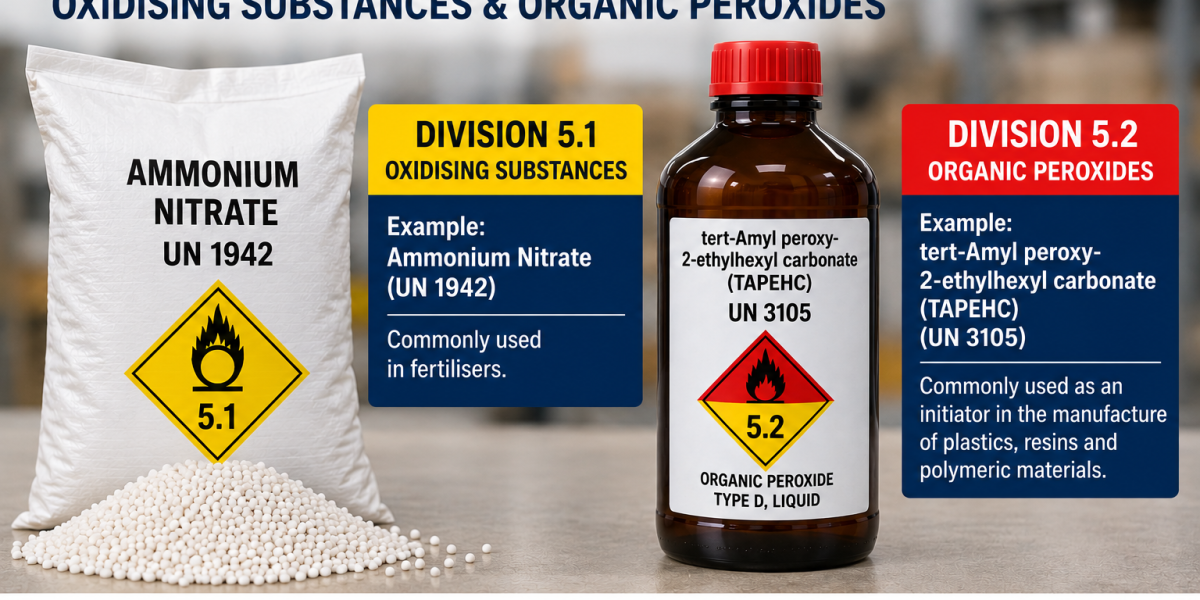
One example is Ammonium Nitrate, UN 1942, which is classified as a Division 5.1 oxidising substance.
Division 5.2 – Organic Peroxides
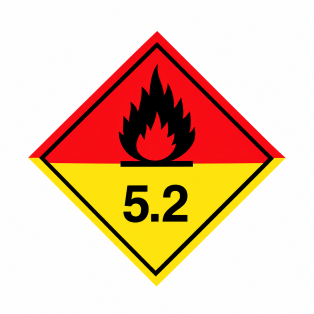
Division 5.2 Organic Peroxides are organic substances which contain the bivalent –O–O– structure. Organic peroxides are thermally unstable substances that may undergo exothermic self-accelerating decomposition.
Depending on the particular substance or formulation, organic peroxides may be liable to explosive decomposition, burn rapidly, be sensitive to impact or friction, react dangerously with other substances, or cause damage to the eyes.
Some organic peroxides also require temperature-controlled transport because excessive heat can initiate dangerous decomposition.
An example is tert-Amyl peroxy-2-ethylhexyl carbonate (TAPEHC), which can be transported under UN 3105 – Organic Peroxide Type D, Liquid, Division 5.2, for the applicable formulation.
Class 5 Dangerous Goods Hazard Labels
The two divisions of Class 5 have different hazard labels to clearly identify the hazard presented during transport.
Division 5.1 Hazard Label
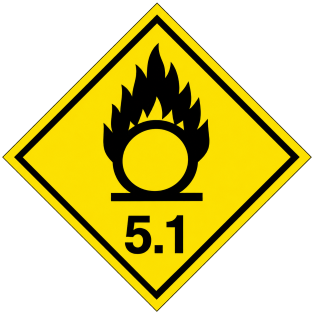
The Division 5.1 Oxidising Substance label has a yellow background with a black flame-over-circle symbol and the number 5.1 at the bottom.
Division 5.2 Hazard Label
The Division 5.2 Organic Peroxide label has a red upper half and yellow lower half, with a flame symbol and the number 5.2 at the bottom.
Why Are Class 5 Dangerous Goods Dangerous?
Class 5 substances require particular care because their hazards can significantly increase the severity of an incident involving other materials.
- Oxidising substances can cause or intensify combustion.
- Organic peroxides can be thermally unstable and undergo self-accelerating decomposition.
- Some substances can react dangerously when contaminated or mixed with incompatible materials.
- Certain organic peroxides may require temperature control during transport.
Packaging Class 5 Dangerous Goods
Packaging requirements for Class 5 Dangerous Goods depend on the specific substance, its classification, the quantity being transported and the mode of transport.
Division 5.1 substances may be assigned a Packing Group according to the applicable regulations. Division 5.2 substances are assigned to organic peroxide types and are subject to specific packing requirements rather than the conventional Packing Group system.
Depending on the organic peroxide, additional requirements may include temperature control, quantity restrictions and specific packaging provisions. The applicable Dangerous Goods Regulations should always be checked for the individual substance being transported.
Segregation of Class 5 Dangerous Goods
Correct segregation is particularly important when transporting Class 5 Dangerous Goods. Oxidising substances and organic peroxides must be kept away from incompatible materials in accordance with the requirements for the relevant mode of transport.
Depending on the substance, incompatibilities can include combustible materials, reducing agents and other substances that could cause a dangerous reaction.
Where Are Class 5 Dangerous Goods Found?
Class 5 Dangerous Goods are used across a wide range of industries. Depending on the specific substance, they may be encountered in:
- Agriculture and fertiliser production
- Chemical manufacturing
- Water treatment
- Laboratories
- Plastics and resin manufacturing
- Polymer production
- Industrial manufacturing
Safe Handling of Class 5 Dangerous Goods
Anyone handling Class 5 Dangerous Goods should understand the hazards of the specific substance and the requirements that apply to its storage, preparation and transport.
- Keep substances away from incompatible materials.
- Prevent contamination.
- Protect packages from excessive heat where required.
- Avoid unnecessary friction, impact or rough handling of organic peroxides.
- Use appropriate personal protective equipment.
- Ensure packages are correctly marked and labelled.
- Follow the applicable Dangerous Goods Regulations and emergency procedures.
Class 5 Dangerous Goods Training
Personnel involved in the preparation, packing, handling, documentation or transport of Dangerous Goods need appropriate training for their responsibilities and the mode of transport involved.
Dangerous Goods training helps personnel understand areas such as classification, packaging, marking and labelling, documentation, segregation and emergency procedures.
We Can Help with Dangerous Goods Training
At Logicom Hub, we provide Dangerous Goods Training covering the transport of hazardous materials by Air (IATA), Road (ADR) and Sea (IMDG).
We offer Public Classroom, Virtual Online, E-Learning and In-House Training, helping individuals and organisations understand their responsibilities when transporting Dangerous Goods.
You can also view our upcoming courses: choose from Public Classroom, Virtual Online and E-Learning training, visit our Courses page or explore the courses below.