 Skip to content


Completing a dangerous goods training session is only the beginning. Real Dangerous goods compliance happens after the session ends—when teams apply IATA, IMDG, ADR, RID, and lithium battery requirements on the floor, under pressure, with real shipments. This 7-step framework gives compliance managers, supervisors, and operations leads a structured path from training day to auditable, lasting on-the-job performance.
A shipment hold. A failed audit. A preventable incident. These are not abstract risks—they are the direct consequences of training that fails to translate into action. And in the dangerous goods sector, the gap between “completed training” and “demonstrated competence” is where most compliance programmes quietly fall apart.
The session runs well. The exam scores look fine. Certificates get filed. Then, three weeks later, an auditor finds mislabelled lithium battery packages. A carrier rejects a consignment. An ADR driver signs documentation they don’t fully understand. The training happened—but nothing changed.
This article is not about how to design training. It’s about what happens next. It’s a practical, step-by-step guide for compliance managers, supervisors, and operations leads who need dangerous goods training to produce real, lasting behaviour change—not just attendance records. Whether you’re managing IATA air compliance, IMDG ocean shipments, ADR road consignments, RID rail movements, or lithium battery handling, the same principle applies: implementation is everything.
Table of contents:
- Why post-training implementation is where compliance is won or lost
- Step 1: Choose the right delivery format and partner
- Step 2: Define learning objectives tied to business outcomes
- Step 3. Analyse your learners and compliance context
- Step 4: Communicate your expectations clearly to your training partner
- Step 5: Ensure training is delivered to competent authority standards
- Step 6: Assess learning and certify competence properly
- Step 7: Support on-the-job transfer — the step most teams skip
- Post-training implementation checklist
- What to do nex
Why post-training implementation is where compliance is won or lost
IATA’s shift to competency-based training and assessment (CBTA), which took effect on January 1, 2023, made this point formally. Under CBTA, the standard is no longer whether your team sat through a course. The standard is whether they can perform their designated functions compliantly—on the job, under real conditions.
As IATA describes it: “Competencies describe what a competent person’s performance on the job should be: a combination of skills, knowledge and attitudes required to perform a task to the prescribed standard.”
Critically, CBTA also requires continuous assessment—not just a post-course quiz. Regulators want evidence that competence is maintained between training cycles. IATA mandates recurrent training every 24 months. ADR renewal falls on a five-year cycle. In every case, what happens between recertifications and dangerous goods compliance is your responsibility as an employer.
That responsibility—and how to meet it—is what this guide addresses.
Step 1: Choose the right delivery format and partner
Implementation success starts before the first session begins. The delivery format and the training partner you choose will either support or undermine everything that follows.
For high-stakes regulations like IATA, IMDG, ADR, and RID, the format must match the audience, the job risk, and the evidence trail you need for audit. That typically means a blended approach:

- E-learning for core knowledge: hazard classes, UN numbers, lithium battery fundamentals, classification rules
- Live sessions (classroom, virtual, or in-house) for application, Q&A, scenario work, and observed practice
- Post-course resources to support on-the-job transfer: quick-reference guides, checklists, job aids
When vetting a training partner, look beyond qualifications. Check that their syllabi are current with the latest regulatory editions. Confirm they can deliver CAA-approved virtual sessions where required. Ask how they support transfer to the workplace after the session ends—not every provider thinks beyond certification.
A partner like Logicom Hub, which has delivered dangerous goods training across IATA, IMDG, ADR, RID, and lithium battery regulations since 2018, builds post-course support into the programme design from the outset. That matters more than it might seem.
Step 2: Define learning objectives tied to business outcomes
If you skip this step, you risk a well-run session that solves the wrong problem. Objectives must connect what happens in training to what you need to improve on the floor.
Start with the business problem. Where are consignment errors occurring? What’s driving shipment holds? What did your last audit find? Then write objectives that describe the on-the-job behaviour you expect to change.
For a team handling lithium batteries for air and road shipments, that might look like:
- Correctly classify common lithium battery shipments and select compliant marks and labels for air and road, without critical errors
- Complete AWB/DGD documentation accurately from a live shipment scenario, verified against a documentation checklist
These aren’t just training objectives—they’re the baseline against which you measure whether implementation has worked. Document them before training begins. Reference them during follow-up. They are your compliance evidence.
Step 3: Analyse your learners and compliance contex
Knowing who you’re training—and what regulations govern their functions—is essential for making training land correctly. A new hire handling air freight shipments needs different support than an experienced road transport supervisor refreshing their ADR certificate.
Before training runs, conduct a focused needs assessment:
- Map roles and risks — Who does what? Where do errors typically occur?
- Check baseline competence — Prior training records, quiz results, audit findings
- Confirm compliance boundaries — Which modes apply? IATA? IMDG? ADR? RID? A combination?
- Identify constraints — Shift patterns, language needs, tech access, class sizes
This analysis shapes how training is structured and how implementation support is designed afterward. It also gives you the data to measure change post-training—which is essential for demonstrating competency improvement to auditors.
Evaluating Training Effectiveness
After designing and delivering training, it is important to evaluate its effectiveness in meeting the desired learning outcomes. This evaluation process involves collecting data on various aspects of the training, such as participant feedback, knowledge retention, and application of skills in the workplace.
One way to measure the success of training is by assessing whether it has helped employees improve their baseline competence. This can be done by reviewing prior training records, quiz results, and audit findings before and after the training. Any improvement in these areas can demonstrate that the training was effective.
It is also crucial to confirm which compliance boundaries apply to your company’s operations when evaluating training effectiveness. Depending on your industry and location
| Ready to build a training programme that holds up to audit? Logicom Hub has delivered dangerous goods compliance training across air, sea, road, and rail since 2018. Talk to our team about your next programme. |
Step 4: Communicate your expectations clearly to your training partner
This step is frequently skipped—and the gap it creates shows up in post-training results.
Your training provider needs to understand more than the regulatory content. They need to know:
- What your teams will be doing immediately after training (live shipments? new SOPs? an upcoming audit?)
- What the known gaps are — mislabelled packages, documentation errors, weak understanding of a specific hazard class
- What evidence you need — pass/fail criteria, practical assessment records, certification scope
- What job aids and resources should be included for teams to take back to the floor
The more precisely you communicate this, the more your provider can tailor delivery and post-course resources to your operational reality. A good training partner will actively seek this information. If they don’t ask, prompt them.
Step 5: Ensure training is delivered to competent authority standards

Once training is underway, your role shifts—but it doesn’t disappear. Compliance managers and supervisors should confirm that delivery meets the standards required by the relevant competent authority.
For air transport under IATA, that means training must address the specific functions each person performs, not just their job title. Under CBTA, function-specific training is mandatory—general awareness training alone is insufficient. For IMDG ocean shipments, Chapter 1.3 of the IMDG Code governs training requirements. For ADR, the relevant provisions are contained in Chapter 1.3 of the ADR regulations.
Key delivery standards to verify:
- Mode-specific content covered correctly (air vs. road vs. sea vs. rail distinctions)
- Practical elements included—not just slide-based delivery
- Assessment conducted against defined criteria, not just attendance recorded
- Virtual delivery conducted via a CAA-approved platform where required for air training
A provider that understands regulatory nuance will build this in automatically. Your job is to confirm it, document it, and retain records. Under IATA and ICAO rules Training records must be kept for a minimum of 36 months for current employees. ADR and IMDG records should be retained for the period of 6 years in the United Kingdom.
Step 6: Assess learning and certify competence properly
Assessment is where training proves itself—and where many programmes fall short. A ten-question multiple-choice quiz measures recall. It does not demonstrate that someone can classify a shipment, apply the correct marks and labels, and complete a DGD without critical errors.
Effective assessment for dangerous goods compliance requires both components:
Knowledge assessment — short quizzes after each module covering classification, marks/labels, documentation, and emergency response
Performance assessment — observed practical tasks, scenario-based exercises, and role-play (for example, handling a carrier hold-call simulation) scored against a defined pass/fail rubric
For lithium battery training specifically, practical evidence matters enormously. Auditors want to see that personnel can select the correct section (II vs IA/IB), apply appropriate marks/labels for air or road, and complete documentation accurately—not just describe how to do it.
What your evidence package should include:
- Exam scores
- Signed practical checklists or observed assessment rubrics
- Photographs of correctly labelled mock consignments (where applicable)
- Copies of completed documentation (AWB, DGD, CMR, etc.)
- Certificates stating the learner, role, modes trained, and assessment outcome
- Assessor names and dates
This documentation is your compliance defence. Store it securely and schedule recurrent training before certification windows close—24 months for IATA, 36 months for 49 CFR, and according to ADR renewal cycles.
| Need a training partner who builds audit-ready evidence into every programme? Contact Logicom Hub to discuss IATA, IMDG, ADR, RID, and lithium battery training tailored to your operation. |
Step 7: Support on-the-job transfer — the step most teams skip
Everything before this step is preparation. This is where training either becomes compliance or becomes a forgotten certificate.
Research on learning retention consistently shows that without structured reinforcement, the majority of training content is forgotten within weeks. The dangerous goods context makes this worse: regulations are detailed, consignment scenarios vary, and teams are often under time pressure. Old habits return fast.
Post-training transfer is not complicated. But it must be deliberate.
Immediately after training:
Distribute job aids and quick-reference guides (marks/labels checklists, documentation templates, hazard class flowcharts)
Brief supervisors and line managers on what was covered and what to look for—they are the first line of reinforcement
Have each learner commit to a specific task they will apply within the next five working days
Week 1:
Supervisor observes one packing/marking/documentation task per learner and signs off on the checklist
Peer review of one consignment per team member against training standards
Week 2:
A short team huddle (10–15 minutes) reviewing two or three tricky scenarios from real shipments
Any errors or near-misses documented and used as learning prompts, not just corrections
Day 30:
Spot audit of three to five consignments across the team
Errors fed back into training records and used to refine the next training cycle
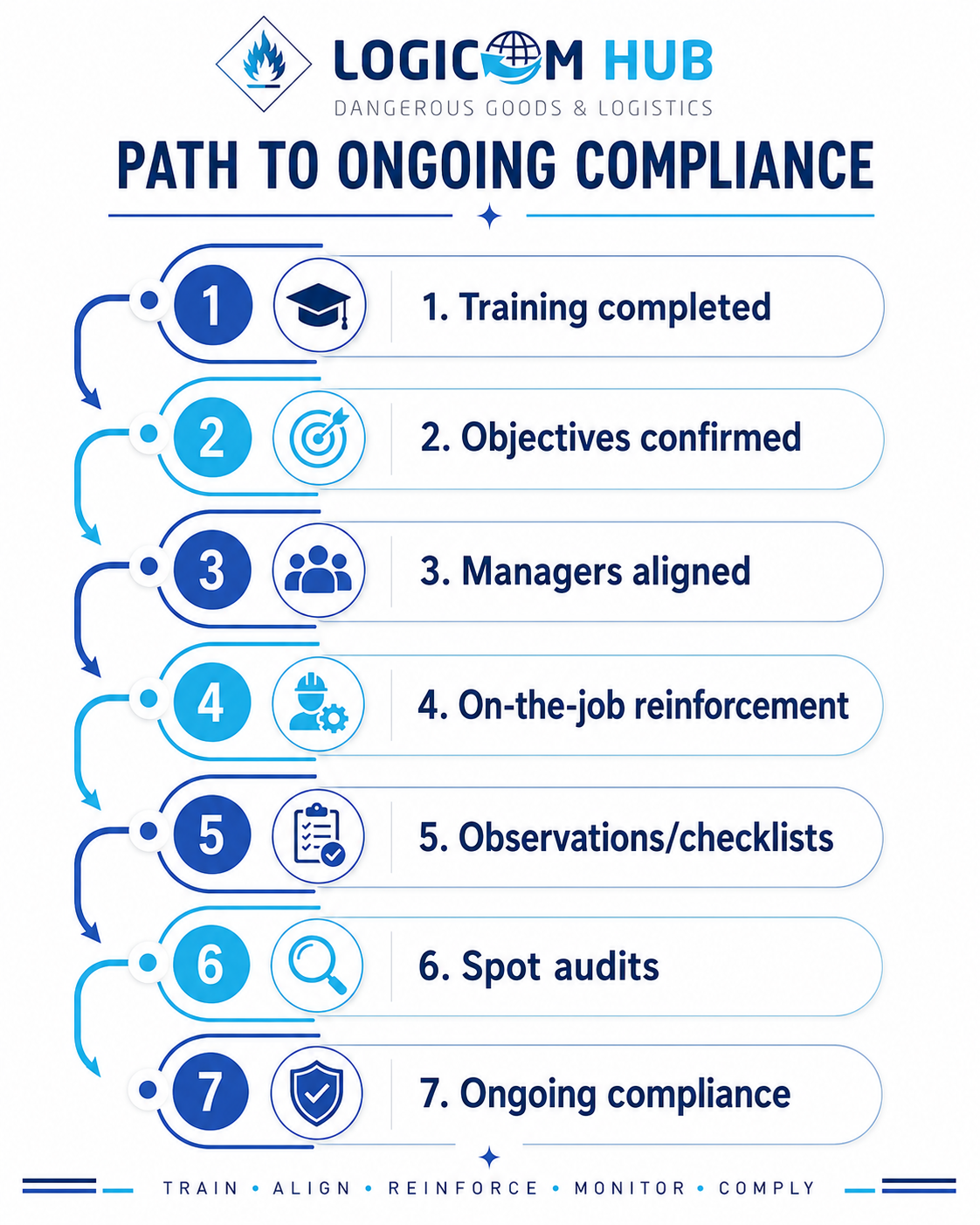
Manager confirms competence in the functions each person performs (this is your CBTA continuous assessment evidence)
The 30-day follow-up cadence is not burdensome. It takes roughly 90 minutes of supervisor time across the month. What it produces—documented competence evidence, reduced error rates, cleaner audits—is worth considerably more.
Post-Training Implementation Checklist: Turning Learning Into Action
Completing a training session is only the beginning. What happens in the days and weeks that follow determines whether your teams apply what they learned or revert to old habits. Use this checklist to drive follow-through, reinforce competence, and build the documented evidence trail that regulators expect.
Before training:
- Learning objectives written and tied to specific business outcomes
- Learner analysis completed (roles, modes, experience levels, compliance gaps)
- Compliance context confirmed (IATA, IMDG, ADR, RID—modes and editions)
- Training partner briefed on operational context, known gaps, and evidence requirements
- Assessment criteria defined in advance (what does “pass” look like for practical tasks?)
- Manager/supervisor briefed on their post-training role
During training:
- Mode-specific content confirmed as covered (function-specific, not just general awareness)
- Practical elements included and observed
- Knowledge assessments completed per module
- Practical assessments conducted with signed rubrics or checklists
Immediately after training:
- Certificates issued with scope clearly stated (learner, role, modes, assessment outcome)
- Job aids and quick-reference guides distributed (marks/labels checklists, documentation templates)
- Evidence package stored (quiz scores, checklists, photos, completed docs)
- Transfer commitments recorded from each learner
Week 1:
- Supervisor observation of one practical task per learner, signed off
- Peer review of at least one live consignment per team member
Week 2:
- Team huddle reviewing tricky scenarios or real shipment cases (10–15 min)
- Errors or near-misses documented and addressed
Day 30:
- Spot audit of three to five consignments
- Supervisor confirms competence in designated job functions (CBTA continuous assessment)
- Feedback documented for next training cycle
Ongoing:
- Recurrent training scheduled before certification window closes (IATA: 24 months; check ADR/RID/IMDG requirements for your operation)
- Training records retained per regulatory requirements (minimum 36 months)
- Current regulatory editions accessible to all DG employees
Make your training count—starting today
Training that ends at the classroom door is not training. It’s an attendance record.
The framework and checklist in this guide give compliance managers, supervisors, and operations leads a practical path from session completion to auditable, lasting competence. The steps are not complicated. They do require intention—and a training partner who supports implementation, not just delivery.
Logicom Hub has designed and delivered dangerous goods training programmes across IATA, IMDG, ADR, RID, and lithium battery regulations since 2018. Every programme is built to produce safe, compliant teams whose competence holds up on the floor and under inspection—not just on the day of the session.
| Talk to Logicom Hub about your next dangerous goods training programme. We’ll work with you to design a programme that fits your operation, your regulations, and your audit requirements—from first session to 30-day follow-up and beyond. |
Frequently asked questions
What is post-training implementation in dangerous goods compliance?
Post-training implementation refers to the structured actions taken after a dangerous goods training session to ensure that learners apply what they were taught on the job. It includes supervisor observations, practical follow-up tasks, documented competence checks, and the distribution of job aids—all designed to close the gap between classroom learning and real-world compliance.
Why is on-the-job transfer important for IATA and ADR training?
Without structured reinforcement, most training content is forgotten within weeks and dangerous goods compliance will lapse. For IATA and ADR compliance specifically, this means teams may revert to non-compliant practices—leading to shipment holds, failed audits, or safety incidents. Structured transfer support ensures training changes behaviour, not just quiz scores.
What is competency-based training and assessment (CBTA) under IATA?
CBTA is the framework IATA mandated from January 1, 2023, for dangerous goods training in air transport. Under CBTA, training must be designed around the specific functions an employee performs—not just their job title—and must include ongoing assessment to verify that competence is maintained, not just demonstrated once at the end of a course.
How often do dangerous goods employees need recurrent training?
Recurrent training frequency depends on the applicable regulation. IATA requires recurrent training every 24 months for air transport. ADR operates on a five-year Vocational Training Certificate cycle for drivers for others recommended with the change of regulations every 2 years. IMDG requires periodic supplementation of initial training, with frequency determined by the relevant competent authority.
What training records are required for dangerous goods compliance?
Training records must include the employee’s name and company name, the date training was completed, a description or copy of training materials used, the trainer’s name and address, and certification that the employee has been trained and tested. Records must be retained for a minimum of 36 months for current employees. IATA, ICAO, and IMDG have equivalent requirements—and current editions of regulations must be accessible to all DG employees.
What should a post-training implementation checklist include?
An effective post-training implementation checklist for dangerous goods compliance should cover: pre-training objective setting and learner analysis; in-session assessment records; immediate post-course actions (job aid distribution, certificate filing, transfer commitments); Week 1 supervisor observations; a Week 2 team review; a Day 30 spot audit; and ongoing recurrent training scheduling. A ready-to-use version is included in the article above.