 Skip to content

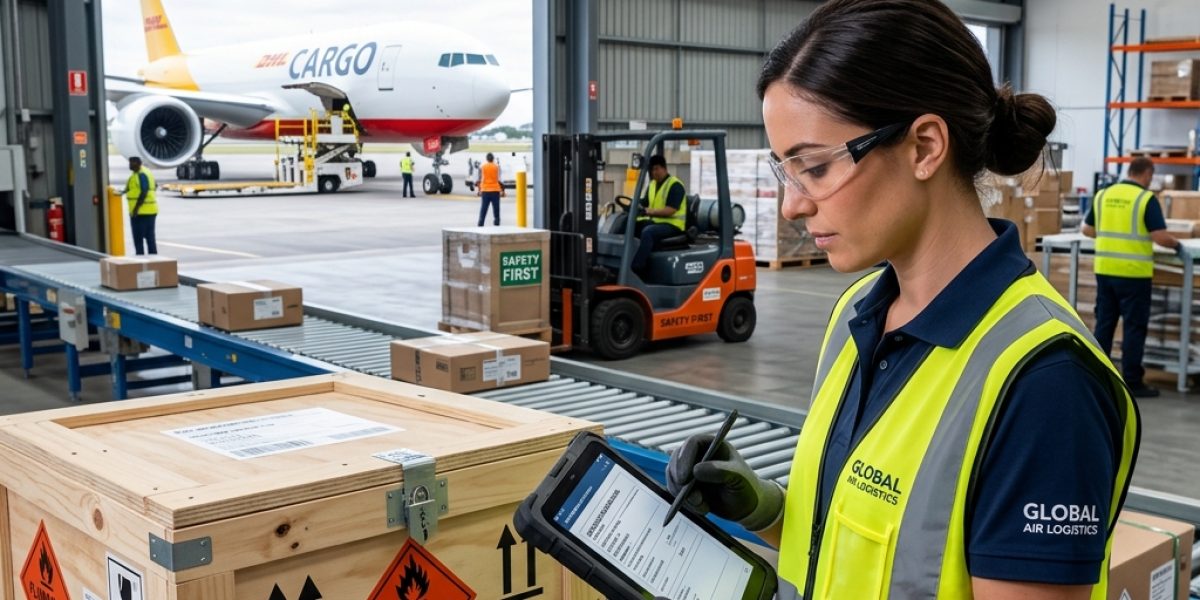
The IATA Dangerous Goods Regulations (DGR) — currently in its 67th Edition, effective January 1, 2026 — set the legally binding rules for classifying, packing, marking, labelling, and documenting all hazardous cargo transported by air. Every manufacturer, distributor, shipper, carrier, and freight forwarder handling Classes 1–9 must comply or face shipment rejection, fines, and potential prosecution.
A rejected consignment at the acceptance desk costs you a missed flight. A compliance failure at 35,000 feet costs far more. The IATA Dangerous Goods Regulations exist to prevent the second scenario — and they hold every link in the air supply chain accountable for getting it right.
This guide was written specifically for air customers: the manufacturers, distributors, shippers, carriers, and freight forwarders who handle dangerous goods Classes 1–9 by air transport. You’ll find a plain-English breakdown of the DGR’s structure, a step-by-step shipment walkthrough, a detailed review of high-risk commodities, the compliance errors most likely to derail your cargo, and the training obligations your organisation must meet. By the end, you’ll know exactly where to find each rule, how to apply it, and how to stay current as the regulations evolve.
What the IATA Dangerous Goods Regulations Cover — and Why Air Customers Can’t Ignore Them
What Is the IATA DGR and Who Does It Apply To?
The IATA Dangerous Goods Regulations is the manual used by dangerous goods shippers, freight forwarders, and air carriers worldwide to manage the risks posed by hazardous materials in air transport. It combines the UN Model Regulations and ICAO’s Technical Instructions with the specific requirements of IATA member airlines — including major cargo carriers such as FedEx and UPS.
The DGR applies to every party who touches a dangerous goods shipment before, during, or after a flight. That means your classification team, your packing staff, your freight forwarder, the accepting airline, and ground handlers all operate under the same rulebook. Ignorance of that rulebook is not a mitigating factor when a civil aviation authority investigates an incident.
Compliance with these regulations is not optional. Failure to follow the correct procedures can result in significant penalties, operational disruption, reputational damage, and serious safety incidents.
How the DGR Relates to ICAO Technical Instructions
The ICAO Technical Instructions for the Safe Transport of Dangerous Goods by Air (Doc 9284) form the international legal baseline. The IATA DGR adopts those instructions and, in some cases, adds stricter requirements — for example, limiting lithium-ion batteries to a 30% state of charge during transport. Civil aviation authorities in each country enforce compliance with both frameworks.
This matters for air customers operating internationally. A shipment that complies with road (ADR) or sea (IMDG) rules may still be prohibited or restricted by air. The DGR sets tighter quantity limits — Class 3 flammable liquids, for instance, are capped at 1 litre per inner receptacle by air versus 5 litres by road — and imposes a 95 kPa pressure performance test that has no equivalent in other modal codes. If your business ships by multiple modes, you need separate procedures for each one.
What Happens When You Get It Wrong?
Non-compliance triggers four categories of consequence. Shipment refusal is the most immediate: an airline’s acceptance agent identifies the discrepancy and turns the freight away. Financial penalties follow, levied by the carrier or the civil aviation authority. Prosecution is possible in cases of deliberate or repeat violations. And if an incident occurs in flight, the liability picture becomes significantly more serious.
The 67th Edition IATA DGR — effective January 1, 2026 — added specific guidance in Section 9.1.3 to address a different problem: “trivial” rejections by cargo screeners based on minor formatting discrepancies that don’t affect safety. IATA has clarified that screeners should not refuse cargo for cosmetic errors that carry no safety implications. That distinction matters, but it doesn’t reduce your obligation to get the substantive rules right.
Inside the DGR Manual: Chapters, Lists, and Tables Explained
How Are the 11 Chapters of the IATA DGR Structured?
The 1,200-page manual is organised into eleven logically sequenced chapters, followed by supporting appendices:
| Chapter | Topic |
|---|---|
| 1 | Applicability — who and what the rules cover |
| 2 | Limitations — forbidden goods, passenger allowances |
| 3 | Classification — hazard classes, packing groups |
| 4 | Identification — UN numbers, Proper Shipping Names |
| 5 | Packing — instructions and performance tests |
| 6 | Packaging Specifications — UN codes, inner receptacles |
| 7 | Marking and Labelling — designs, sizes, placement |
| 8 | Documentation — Shipper’s Declaration, air waybill text |
| 9 | Handling — segregation, storage, emergency response |
| 10 | Radioactive Materials — dedicated rules, Transport Index limits |
| 11 | Compliance and Training — CBTA, record keeping |
Appendices add definitions, conversion tables, state and operator variations, and sample forms.
Tab the main sections before your first shipment. Knowing where to find information quickly is itself a compliance skill — an inspector giving you a limited window to justify your documentation expects a confident page-turn, not a frantic search.
What Are the Nine Classes of Dangerous Goods Under the DGR?
Quick reference table:
| Class | Label | Typical examples |
|---|---|---|
| 1 | Explosive | Flares, airbags |
| 2 | Gas | Aerosols, propane |
| 3 | Flammable liquid | Paint, petrol |
| 4 | Flammable solid | Matches, metal powders |
| 5 | Oxidiser/Peroxide | Fertiliser, bleach kits |
| 6 | Toxic & Infectious | Pesticides, clinical samples |
| 7 | Radioactive | Medical isotopes |
| 8 | Corrosive | Acids, wet batteries |
| 9 | Miscellaneous | Lithium batteries, dry ice |
Subsidiary risks and packing groups refine these broad categories when you consult the Dangerous Goods List in Table 4.2.
Which DGR Reference Tables Do Air Shippers Use Most?
Table 4.2 is the manual’s operational heartbeat. Read it left to right: UN number → Proper Shipping Name → class and sub-risk → packing group → passenger and cargo quantity limits → packing instruction. That single row tells you almost everything you need before you open a box.
Tables 2.3.A and 2.3.B govern passenger baggage allowances. Section 4.4 contains special provisions that override or supplement the standard table entries. Chapter 1 lists state and operator variations — the carrier-specific or country-specific additions that can tighten the DGR’s base rules without warning.
Check operator variations before every booking. A carrier may refuse a commodity class that the DGR otherwise permits. A quick pre-submission email to the airline saves a costly freight return.
How Often Does the IATA DGR Change?
A new edition takes effect on 1 January each year. IATA also issues interim addendum online throughout the year. The 67th Edition — the current edition — became mandatory on 1 January 2026. Order the next edition in October, brief your team in November, and switch all SOP references on the first working day of January..
Preparing and Offering a Dangerous Goods Shipment Step by Step
What Is the Correct Process for Classifying a Dangerous Goods Shipment by Air?
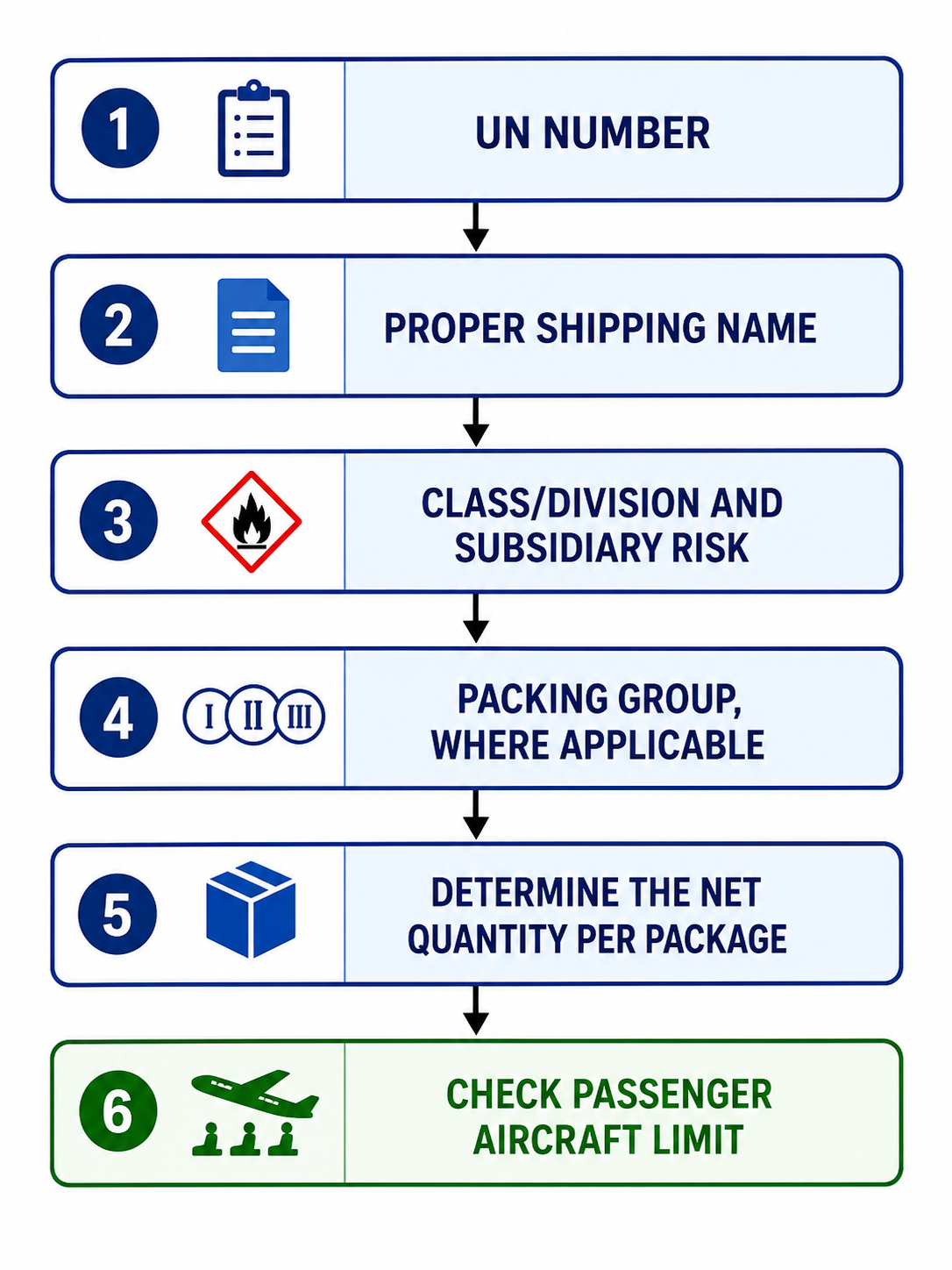
Start with the Safety Data Sheet or test data. You need three outputs:
- Primary hazard (flash point, toxicity, activity).
- UN number and Proper Shipping Name – e.g.
UN 1263 PAINT. - Subsidiary risk and Packing Group (I, II or III).
Confirm every entry against Table 4.2. If several entries fit, choose the most specific. Record the classification in your internal dangerous goods register — auditors and acceptance agents will ask for it.
How Do You Select the Correct Packaging for Air Transport?
The Packing Instruction in Table 4.2 tells you which packaging configuration applies. Lithium-ion cells shipped alone use PI 965. Paint at Packing Group II uses PI 353. Every outer package must carry a UN specification code — for example, 4G/X25/S/25/GB/1234 — proving it passed the required drop and pressure performance tests. Before you seal the package, confirm:
- Inner receptacle limits
- Cushioning compatibility
- Need for combination or single packaging
- Overpack? Affix “OVERPACK” in 12 mm text and repeat marks visible inside.
What Marking and Labelling Does an Air Dangerous Goods Shipment Require?
Apply all marks and labels before you close the package — not afterwards. The minimum requirements for the outer packaging are:
- UN number and Proper Shipping Name
- Gross and net quantity in kg or L
- Sender/consignee details (if no overpack)
- Orientation arrows for liquids
Labels measure 100 × 100 mm unless the DGR specifies otherwise. Affix the primary hazard label, any subsidiary risk label, and relevant handling marks — such as the lithium battery mark or “Cargo Aircraft Only.” Maintain a 12 mm clearance from the package edge and never place a label over a closure seam. Labels peel from seams under handling stress and will be unreadable at acceptance.
How Do You Complete the Shipper’s Declaration for Dangerous Goods?
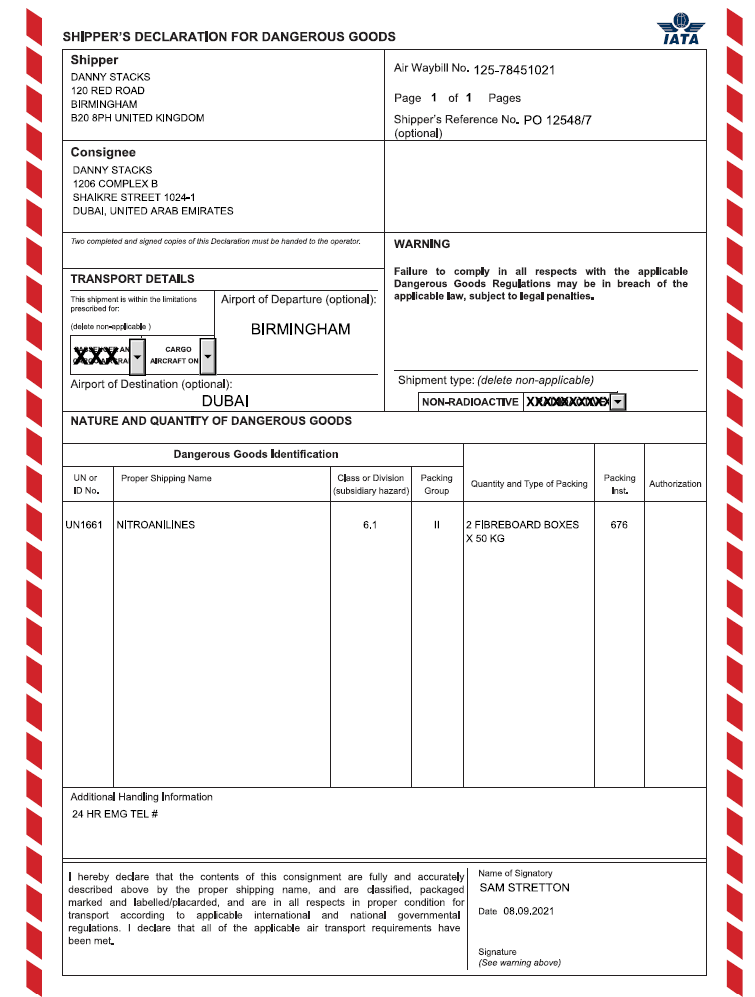
The red-bordered Shipper’s Declaration is the document that makes a dangerous goods shipment legal for air transport. Complete it in this sequence: UN number → Proper Shipping Name → class and division → subsidiary risk → packing group → quantity and packaging type → packing instruction reference.
Use a decimal point, not a comma, for quantities (1.5 L, not 1,5 L). Include the closure torque value for liquid packages. Reference the current DGR edition — the date on the form must reflect the 67th Edition if you are shipping in 2026.
The air waybill needs a “Dangerous goods as per associated DGD” statement, or a “Not restricted” notation for Section II battery shipments that qualify for the simplified documentation pathway.
What Does Airline Acceptance Involve for Air Dangerous Goods?
The accepting agent works through an 11-point checklist covering documentation accuracy, packaging integrity, label placement, quantity compliance, and pilot notification. Common reasons for refusal include an outdated DGR edition cited on the declaration, a missing closure torque statement, and a net weight figure that doesn’t match the packaging. Pre-screen all state and operator variations in Section 2 before you hand over the freight.
Special Provisions for High-Profile Hazardous Items
What Are the 2026 IATA DGR Rules for Lithium Batteries?
The IATA Dangerous Goods Regulations (DGR) are constantly being updated to ensure the safe transport of hazardous materials, including lithium batteries. As of January 1, 2026, new rules will come into effect regarding the transport of lithium batteries by air.
Certification and Training Requirements
One of the major changes is the requirement for shippers and freight forwarders to certify that all personnel involved in preparing or offering lithium batteries for transport have received appropriate training. This training must be refreshed every two years.
Restrictions on Lithium Ion Batteries
In addition, there will be stricter quantity limitations and packaging requirements for lithium ion batteries. These changes aim to reduce incidents caused by thermal runaway in large
Lithium batteries are the single most regulated commodity in the current edition — and the 67th Edition introduced a significant change that affects every shipper of cells and batteries by air.
As of 1 January 2026, the 30% state-of-charge (SoC) limit is now a mandatory requirement, not a recommendation, for the following:
- UN 3480 — lithium-ion batteries shipped alone (previously a recommendation; now mandatory)
- UN 3481 — lithium-ion batteries packed with equipment, where cells exceed 2.7 Wh or the battery exceeds 100 Wh
- UN 3551 — sodium-ion batteries (new explicit coverage in the 67th Edition)
- Hybrid battery assemblies containing both lithium-ion and sodium-ion chemistries
The practical threshold is 30% of rated design capacity, or an indicated charge of 25% — whichever your equipment reads. This is not a paperwork change. Your packing team needs a documented, repeatable method to verify SoC before sealing each package. For consumer electronics, that usually means a partial-discharge step on the production line. For replacement battery stock, it means tighter controls on incoming inventory.
Larger cells and batteries — those that fall into Section IA or IB of PI 965 — require a full Shipper’s Declaration and are subject to additional carrier scrutiny. Section II shipments (smaller cells, ≤ 20 Wh per cell or ≤ 100 Wh per battery) avoid the DGD if all conditions are met, but still require the lithium battery mark (135 × 113 mm) and a limit of two Section II packages per consignment.
In the first months of the 67th Edition, the most common acceptance refusals for lithium battery shipments have involved: no documented SoC evidence, an incorrect packing instruction reference, UN 3480/UN 3481 confusion on multi-piece consignments, and mislabelling on overpacks.
How Are Infectious Substances Classified and Shipped by Air?
The DGR separates infectious substances into two categories:
- Category A (UN 2814 / UN 2900): Substances capable of causing permanent disability or life-threatening disease. These require PI 602, a full Shipper’s Declaration, and carrier pre-approval.
- Category B (UN 3373): All other infectious substances. PI 650 applies, no DGD is required, but triple packaging — primary receptacle, secondary packaging, rigid outer — is mandatory.
Dry ice (UN 1845, Class 9) is frequently used as the refrigerant for biological samples. Mark the net weight in kilograms beside the dry-ice label and ensure the package design allows CO₂ venting to prevent pressure build-up.
What Rules Apply to Radioactive Materials Shipped by Air?
Packages are graded I-white, II-yellow or III-yellow using the Transport Index (TI) formula:TI = (max mSv/h at 1 m) × 100.
Category II and III need the TI on the label and may trigger routing restrictions or carrier pre-approval.
What Are Limited Quantities and Excepted Quantities Under the DGR?
Limited Quantities (LQ) permit up to 1 litre or 1 kilogram per inner receptacle (the limit varies by class) under the Y-diamond mark. The Shipper’s Declaration is not required for LQ shipments. Excepted Quantities (EQ) go further — inner limits drop to as little as 30 ml or 30 g, identified by the E-code mark. Neither pathway removes the obligation to package correctly and check that your commodity is eligible for the reduced regime.
Convert volume to net mass using density × volume. Stay inside the threshold — a package that marginally exceeds an EQ inner limit reverts to full DGR requirements.
Typical Compliance Errors and How to Avoid Them
What Are the Most Common Misclassification Errors in Air Dangerous Goods Shipments?
- Treating a high-flash paint as UN 1263 when SDS Section 9 data place it under “flammable liquid, n.o.s.” — a different entry with different quantity limits.
- Assigning UN 3481 (lithium-ion battery contained in equipment) to a power bank shipped loose — the correct entry is UN 3480.
- Defaulting to Packing Group II without checking the SDS. Always verify flash point, toxicity, or other classification criteria before you assign a group.
What Packaging Errors Lead to Air Cargo Rejection?
- Using a UN box certified for solids (marked “S”) to ship liquids. The pressure performance test is absent from that certification; the package will be rejected.
- Omitting the closure torque value on the Shipper’s Declaration. Airlines expect it — and its absence is treated as a documentation failure, not an oversight.
- Reusing fibreboard cartons after water exposure. Moisture destroys edge crush strength. A carton that passed the drop test when new will fail it wet.
- Missing the Overpack Label
- Missing the Id number if there are multiple overpacks.
Which Documentation Mistakes Trigger Shipment Refusal?
- A decimal comma in the quantity column (“1,5 L” instead of “1.5 L”). A small error with a large consequence.
- Incorrect spelling of the proper shipping name.
- Omitting the “OVERPACK USED” statement when inner package marks are obscured by an outer overpack.
- Forgetting to sign the document.
What Operational Errors Create Risk During Handling and Loading?
- Placing Class 5.1 oxidisers in the same ULD as flammable goods. The DGR segregation table exists to prevent exactly this combination.
- Allowing lithium battery freight to sit in direct sunlight. Cell temperature approaching 60°C increases thermal runaway risk — and exceeding that threshold during ground handling can constitute a compliance failure.
- Affixing hazard labels over closure seams. The label will separate under handling stress and arrive at acceptance unreadable.
Training and Competency Requirements Under the DGR
Who Must Be Trained in IATA Dangerous Goods Regulations, and to What Level?
The DGR defines training categories A through H, each covering a different job function:
| Category | Role |
|---|---|
| A | Shippers preparing the Shipper’s Declaration |
| B | Packers |
| C | Freight acceptance agents |
| D | Passenger and cargo acceptance staff |
| E | Ground handlers |
| F | Flight crew |
| G | Security screeners |
| H | Passenger-facing staff |
The depth of required knowledge scales with risk. A Category A shipper must understand classification, packing, marking, labelling, and documentation in full. A Category H check-in agent needs enough knowledge to ask the right questions about passengers’ carry-on items.
A–H categories span shippers, packers, freight agents, airline acceptance staff, ground handlers, flight crew, security screeners and passenger-facing staff. Depth of knowledge scales with risk: Category A writes the declaration; Category H simply asks baggage questions.
From Traditional to Competency-Based Training and Assessment (CBTA)
To find out more regarding Competency Based Training and Assessment see our other blog.
Key Takeaways
- The 67th Edition IATA DGR is in force from 1 January 2026. Every SOP, declaration template, and training module should reference this edition now.
- The 30% state-of-charge limit for lithium-ion batteries is a mandatory requirement under the 67th Edition — not a recommendation. Verify SoC at the point of packing and document it.
- Follow the five-step preparation sequence without exception: classify, pack, mark and label, document, and pass acceptance. Skipping or reordering steps is the fastest route to a rejection.
- Check operator and state variations for every booking. Carrier-specific rules can prohibit what the DGR base text permits.
- Recurrent training is due every 24 months. Keep records for three years. Don’t allow certificates to lapse.
- Update manuals, SOPs, and software on 1 January each year — and after every interim addendum.
Compliance with the IATA DGR becomes routine once your classification, packing, and documentation workflows are properly embedded. The rules are demanding, but they’re also consistent — the same logic applies across every commodity and every flight.
Need IATA-aligned dangerous goods training for your team? Visit Logicom Hub to explore course options across e-learning, classroom, and in-house formats — and turn the rulebook into everyday operational confidence.
Frequently Asked Questions
What is the IATA Dangerous Goods Regulations manual?
The IATA Dangerous Goods Regulations (DGR) is the internationally recognised manual that sets the rules for transporting hazardous materials by air. It is built on ICAO’s Technical Instructions and the UN Model Regulations, with additional requirements from IATA member airlines. The manual covers classification, packing, marking, labelling, documentation, handling, and training. It is updated annually, with a new edition taking effect on 1 January each year.
Which edition of the IATA DGR is currently in force?
The 67th Edition of the IATA DGR is currently in force, effective 1 January 2026. All Shipper’s Declarations, SOPs, and training materials must reference this edition. The 68th Edition will take effect on 1 January 2027 and will include updates to infectious substance classification, organic peroxide lists, and explosive segregation criteria, as detailed in the 67th Edition’s Appendix H.
Is the 30% state-of-charge limit for lithium batteries mandatory in 2026?
Yes. Under the 67th Edition IATA DGR, the 30% state-of-charge limit is now a mandatory requirement for UN 3480 (lithium-ion batteries alone), certain UN 3481 shipments (batteries packed with equipment where cells exceed 2.7 Wh or battery exceeds 100 Wh), UN 3551 (sodium-ion batteries), and hybrid battery assemblies. This limit was previously a recommendation in the 66th Edition.
What is the difference between Limited Quantities and Excepted Quantities under the DGR?
Limited Quantities (LQ) allow small amounts of certain dangerous goods — typically up to 1 litre or 1 kg per inner receptacle — without a Shipper’s Declaration, under the Y-diamond mark. Excepted Quantities (EQ) allow even smaller amounts — sometimes as low as 30 ml or 30 g — using the E-code mark. Both regimes have commodity-specific eligibility criteria. Exceeding the inner quantity limits for either regime removes the exemption and reinstates full DGR compliance requirements.
How often does IATA dangerous goods training need to be renewed?
The IATA DGR requires recurrent training and reassessment every 24 months for all trained personnel. The cycle restarts earlier if a significant regulation change occurs or if a compliance incident takes place. Training records — including course syllabus, assessment results, and assessor credentials — must be retained for a minimum of three years.
What is the difference between a state variation and an operator variation in the DGR?
State variations are additional requirements imposed by individual countries on top of the DGR’s base rules — for example, Thailand, France, and the UK each have updated state variations in the 67th Edition. Operator variations are carrier-specific restrictions submitted by individual airlines. Both types can prohibit or restrict commodities that the DGR base text otherwise permits. Always check both before tendering a dangerous goods shipment to any carrier.
Can a freight forwarder be held liable for a dangerous goods compliance failure?
Yes. Freight forwarders who accept, handle, or document dangerous goods shipments fall within the DGR’s scope and carry specific compliance obligations. If a forwarder signs a Shipper’s Declaration, they are legally accountable for its accuracy. Civil aviation authorities can hold freight forwarders liable for documentation failures, incorrect classification, and acceptance of improperly prepared consignments — regardless of whether the shipper originated the error.