 Skip to content

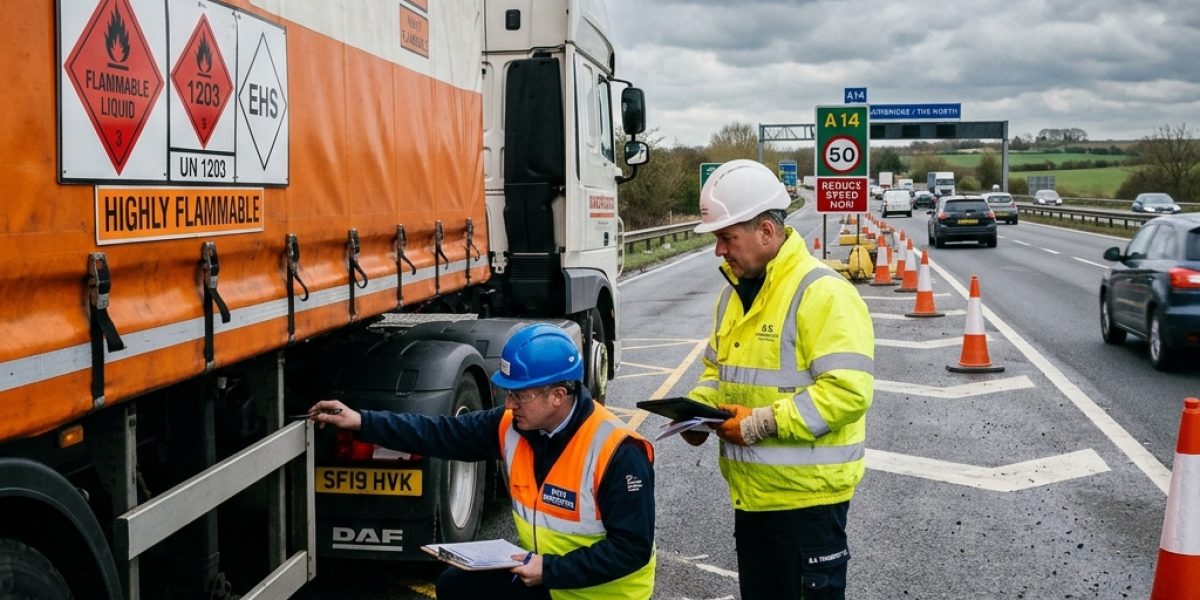
What Transport Companies and Drivers need to know about ADR Driver Training
Quick answer: Any driver transporting dangerous goods needs training.
- If your load is above exemption thresholds you need an ADR certificate, valid for five years.
- If your load is below the exemption threshold you need an ADR awareness training.
Important: Employers must ensure their drivers are trained and certified for the loads they carry. Non-compliance risks prosecution, fines and vehicle impoundment — far outweighing the cost of training.
You know dangerous goods need trained drivers. What you might not know is exactly who needs certification, what the process involves, and where the responsibility sits between company and driver. Get any of these wrong and the penalties are steep.
This post cuts through the confusion. Whether you run a fleet or drive the vehicles yourself, here’s what you need to know about ADR Driver training — who needs it, how it works, and what it costs to get it wrong.
Who legally needs ADR Driver Training?
The rule is straightforward. If you transport dangerous goods by road above the defined exemption thresholds, you need a valid ADR certificate. Full stop.
Those thresholds depend on the type and quantity of the substance. Small volumes of some goods — a few tins of flammable paint, for example — may fall under the exemption limits. But bulk quantities of fuel, chemicals or other hazardous materials almost always require full certification.
This applies across vehicle types: rigid lorries, articulated vehicles and tankers. And since 2007, it’s not just vehicles over 3.5 tonnes — any vehicle carrying dangerous goods above the thresholds is in scope.
A few points to be clear on:
- Waste carriers transporting hazardous waste need ADR Driver training.
- Fuel bowsers, fireworks deliveries and tanker loads all require close attention to classification and quantity limits.
- Exemptions are limited. They don’t apply to most professional, commercial or waste-carrying journeys.
If you carry goods below the threshold a simple Driver ADR Awareness course will suffice. If in doubt, assume you need an ADR Driver certification and confirm before you drive. Guessing wrong is not a risk worth taking.
What does the ADR Driver training process involve?
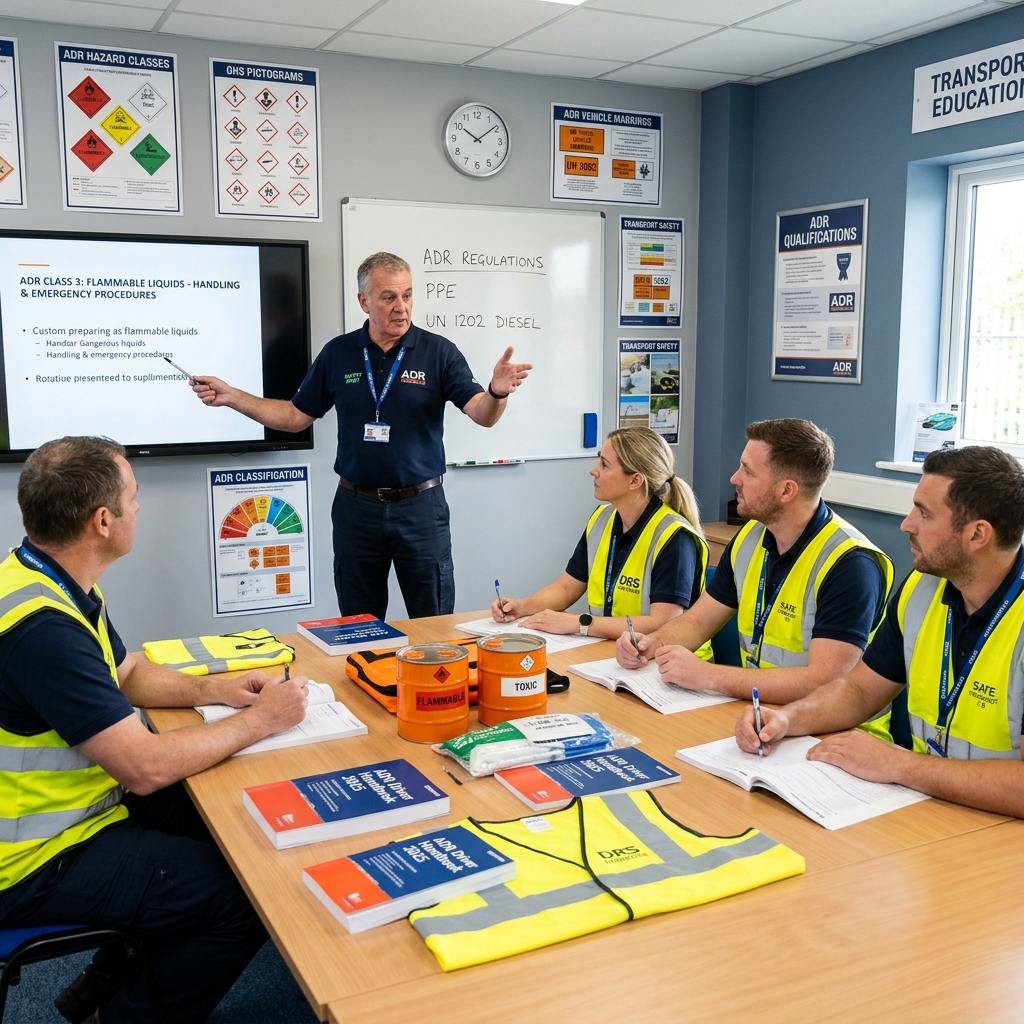
The ADR Driver qualification follows a clear path. Here’s what to expect from start to certificate.
- Choose your modules. Everyone completes the core module. You then add the hazard classes and specialist modules relevant to what you carry — Packages, Tanks, and classes 1 to 9 as needed.
- Attend the course. A standard initial course runs around 3.5 days for core and packaged classes, with an extra day for the tanks module. Training combines classroom theory with practical exercises, including a fire extinguisher drill.
- Sit the exams. Testing is by computer-based multiple-choice exam. The core module has 40 questions, class modules 15 each, and the tanks module 20. You need at least 70% in each section to pass.
- Receive your certificate. Pass all required modules and you’re issued an ADR Driver certificate card, valid for five years.
- Renew before it expires. Take refresher training and exams within the final 12 months before your certificate lapses. Let it expire, and you retake the full initial course from scratch.
Fail a module? You can usually resit it without redoing the whole course. But planning to pass first time saves you both time and money.
Transport companies vs. individual ADR drivers: who is responsible for what?
Responsibility for ADR compliance is shared — but it’s split in specific ways. Knowing where your duties lie protects you from nasty surprises.
| Responsibility | Transport company | Individual driver |
|---|---|---|
| Ensuring drivers are trained and certified for their loads | ✔ | |
| Holding a valid ADR certificate | ✔ | |
| Booking and funding training (often) | ✔ | |
| Keeping certification up to date | ✔ (tracking) |
Dangerous Goods Safety Advisor (DGSA): What You Need to Know
Do you need a Dangerous Goods Safety Advisor (DGSA)? This is a critical role for ensuring compliance and safety in the transport of hazardous materials. For companies involved in the transport, loading, or unloading of dangerous goods, appointing a DGSA is a legal requirement under ADR regulations. Their responsibilities include monitoring compliance with regulations, preparing annual reports, and advising on safe operational practices.
While ADR drivers focus on their immediate duties, such as holding a valid ADR certificate and safely handling goods, the DGSA provides oversight to ensure the entire operation remains compliant. The DGSA’s expertise helps identify risks, establish response protocols, and minimize the potential for incidents, creating a safer and more efficient working environment for everyone involved.
If you are not sure if you need a DGSA, please complete a simple questionnaire – Do I need a DGSA?
If you need ADR Driver Training or a DGSA to support your business, please do not hesitate to contact the team at Logicom Hub. Call: 0330 912 5041 or email: [email protected]